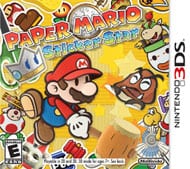
Get Me My Goo Gone
Paper Mario: Sticker Star unarguably addresses one of the longest standing complaints against the Mario franchise and its multitudinous incarnations: It refuses to simply be more of the same. Despite the familiar Paper Mario name, this is far from a retread of what has been done before, but whether or not it serves as a positive departure from the status quo is something a bit less certain.
Visually, this is the most papery Paper Mario yet. Not only are the characters flat, paper constructs, but the levels and buildings are largely made of cardboard (as is Mario’s health bar), while environmental effects such as water and sand throw off small circles of construction paper when they splash against something.
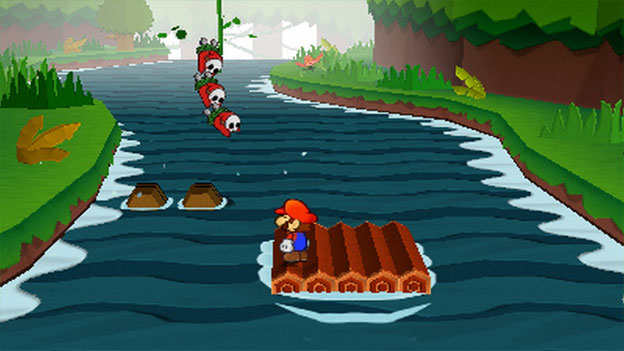
As you might expect, a paper world means that objects don’t always behave as one would expect. Clouds can be bumped by other objects and flipped around, enemies fold themselves up to attack, status effects include being “crumpled” or “soggy,” and the world itself can be violently reshaped, staircases and even entire buildings springing into being around you when you instigate such change. In a way, this feels like Nintendo going for broke, really committing to the diorama-like nature of the Paper Mario series.
Along those lines, there are objects one can find in the world that are clearly not made of paper. These three-dimensional, polygonal “things” (the game deems them such) serve an important purpose in both combat and puzzle¬-solving (often both), because they can be converted into rare and powerful stickers.
Stickers are the crux of Paper Mario: Sticker Star. They can be bought in stores, knocked out of question-mark blocks, won in combat, or even peeled from the walls and floor. Functionally, they are your everything. Stickers are how you solve puzzles and fight enemies. Just as in card-based RPGs, such as Baten Kaitos and Kingdom Hearts: Chain of Memories, Mario is incapable of attacking without the aid of a collectible item—the aforementioned stickers. He keeps them in a book on the bottom screen, initially with two pages of space, but this expands alongside the repertoire of stickers one can obtain.
The basic mechanics of combat will be familiar to Paper Mario veterans, in that it’s turn-based and there’s a timing mechanic that enhances most attacks and provides Mario with a more effective defense. Attacks are always chosen, though, by picking a sticker, at which point it is consumed. Stickers generally fit into one of a few overarching types, but there’s both variety and scale within those, as players will find not only jumps and hammers that behave differently, but more damaging (and rarer) versions of the same. There is also a slot reel that may be spun for the chance to use multiple stickers in a single turn, as well as garnering more direct effects on combat with particularly exceptional spins.
Largely, though, the combat breaks down to the quality of one’s collection, which can generally be handled pretty organically with what one collects in a given level; money is usually ubiquitous enough that purchasing a solid stock of basic stickers from the shop in the game’s main town is within reason, though special stickers, created with the aforementioned polygonal objects, are significantly more expensive, and also of paramount importance when it comes to solving puzzles.
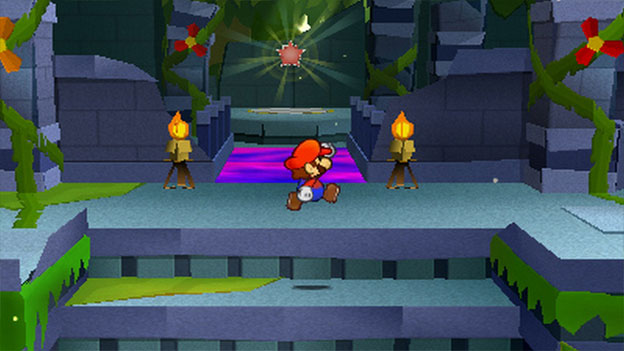
The puzzles in Paper Mario: Sticker Star take a few forms. There are platforming sections, brain-teasers, and environmental puzzles, such as mazes. The fact is, though, that these puzzles are the actual focus of Sticker Star, rather than the combat. In fact, this latest Paper Mario’s RPG trappings are so thin that there isn’t even a leveling system to speak of. The sticker album expands at set points in the narrative, Mario gains more HP when you find an HP¬-up collectible in the environment, and rather than gaining increased attack power or defense, Mario simply comes across better stickers with greater frequency the farther one moves into the game.
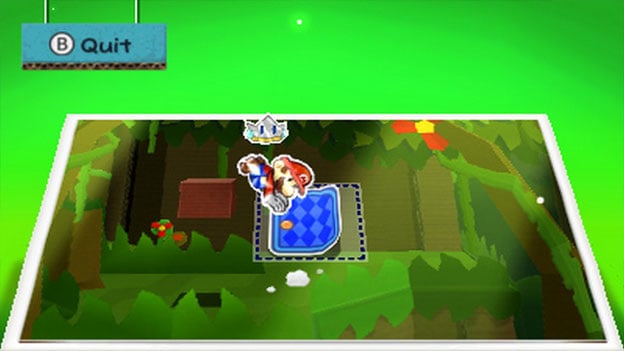
This makes Paper Mario: Sticker Star a very bipolar experience; it desperately wants to be an adventure game in the traditional vein, with puzzles that are solved by either interacting with objects in the environment or using items from one’s inventory to surpass obstacles. The former can involve exploration and dexterity, but the latter is almost exclusively the purview of the Paperize mode, in which certain pieces of the environment can be pulled off and rearranged, or placed down where they had once been. Alternatively, stickers may often be required in specific spaces (there is typically a signal in the environment that this is what must be done).
On the other hand, the title also has the battle system of an RPG, but lacks the traditional sense of constant progression that makes such turn-based battles entertaining. Here, where the only reward is coins (which you’re effectively expending when you use stickers to defeat your foes) I actually found myself actively avoiding battle, particularly in zones I’d already been to (enemies respawn if you exit and reenter from the world map).
Ah, yes, there’s a world map. The game is divided into short stages, which is great in that it allows for bite-sized, portable experiences (and this game is most definitely best played in short bursts when the urge strikes). It contributes, though, to the overall lack of cohesion in the game’s world, and does nothing to elevate the oddly sub-par storytelling of the game.
In fact, it’s the story you’ll notice before the gameplay starts to gnaw at you. Even for a Mario game, the plot is weak, with a brief introduction of an annual, sticker-themed celebration. Bowser appears and immediately makes a lunge for the titular Sticker Star, the MacGuffin that ends up empowering him and a bunch of other baddies who then wreak havoc off-screen (including kidnapping Peach, of course), and Mario is tasked with defeating them both by tradition and his latest companion. Paper Mario games in the past, though, have developed the story as they’ve gone along, building up the world they take place in as the action gets increasingly intense, Mario collects party members (or at least engages with interesting NPCs), and things draw to a climactic showdown. Here, anything other than Mario’s almost leisurely quest to collect the Royal Stickers is completely off-screen, and it’s kind of lonely, which is exacerbated by the hilarious dialogue one does encounter from time to time being juxtaposed with so much utter silence.
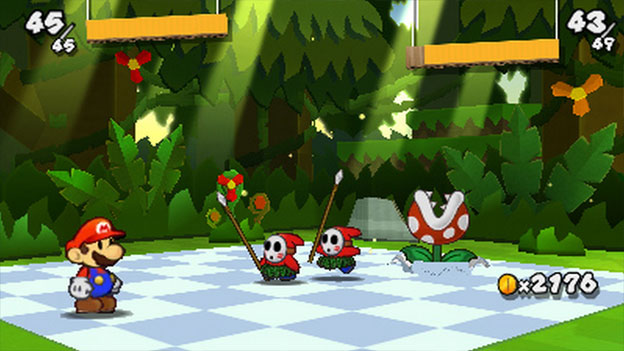
Eventually, though, you’ll stop hoping for the atmosphere to improve and just accept that it’s the depressing way of things. After that, though, you’ll quickly get fed up with the nearly pointless combat and a puzzle-solving system that punishes you for experimentation and demands excessive backtracking. Any time a sticker is used, even if that means it was placed in the environment in hopes of solving a puzzle, it is consumed. This applies to any sticker, whether a regular combat ability or a rare “thing” based sticker. This can quickly get expensive, which makes the trial-and-error methodology the game seems to demand (puzzles have exactly one solution and often lack context, since it’s not really clear what most special stickers will do).
It’s doubly infuriating since, often, solving a puzzle or defeating a boss means backtracking to town so you can create the special sticker you need (which is quite expensive), especially since most rare stickers take up a lot of inventory space and you almost never know which ones you’ll actually need.
The game’s superfluous combat and unforgiving puzzle-solving mechanics only serve to bog the experience down; I can only assume that, without them, Sticker Star would have been infinitely crisper and more enjoyable, but whether they’re an attempt to cater in some way to the “expectations” one has when playing a Paper Mario game or simply a fairly transparent means of padding the length of the game, they do a lot to tarnish what is otherwise a colorful, joyful experience.
RATING OUT OF 5 RATING DESCRIPTION 4.5 Graphics
The visuals are colorful and playful, taking the papercraft of Paper Mario games past to hilarious extremes. Perhaps the best effect is that shiny stickers in the album will actually shimmer as though catching the light when one tilts the system. The 3D is also both forgiving and inoffensive; I generally kept it on. 4.0 Control
Pretty much the definition of simplicity. Whether navigating the world or menus, they are responsive and accurate. 4.0 Music / Sound FX / Voice Acting
Some of the tracks are stellar and, while there’s nothing in the way of spoken dialogue, sound effects are satisfying and appropriate. 2.0 Play Value
Sticker Star cannot decide whether it wants to be played in quick spurts or lock you in for long hours of activity. While it leans toward the former, missteps like the battle system and obtuse puzzles increase the time commitment per section arbitrarily. 3.3 Overall Rating – Fair
Not an average. See Rating legend below for a final score breakdown.
| Review Rating Legend | |||
|---|---|---|---|
| 0.1 – 1.9 = Avoid | 2.5 – 2.9 = Average | 3.5 – 3.9 = Good | 4.5 – 4.9 = Must Buy |
| 2.0 – 2.4 = Poor | 3.0 – 3.4 = Fair | 4.0 – 4.4 = Great | 5.0 = The Best |
Game Features: