Classic Look, Modern Fun
Lately, developers creating RTS games have strayed away from large-scale gameplay. Instead, they’ve opted to produce gameplay that focuses on smaller engagements with specialized units such as in Company of Heroes and Dawn of War II. But what happens when a small group of gamers with a passion for game design don’t like the current methods of mainstream developers?
Enter Arcen Games, a very small company focusing on 2D game design, and you get your answer in AI War: Fleet Command. Unlike mainstream RTS games, AI War wasn’t designed with story in mind. You won’t find a well of lore to dig through. In its place, AI War presents a simple conflict, it’s you vs. the computer.
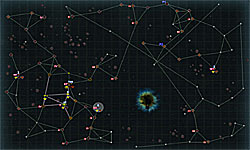
The game features only one gametype, which is effectively a cooperative mode against AI opponents. There is absolutely no player vs. player gameplay to be had, and that’s the idea. Each game pits up to 8 players against 2 AI enemies. The maps are randomly generated prior to playing each game by selecting the number of planets and the complexity of how those planets are connected via wormholes. In this way, AI War is very similar to Sins of a Solar Empire, which can also generate maps based on player input. While the lack of player vs. player gametypes is discouraging, and the inability to set the number of AI you’ll face seems rather restrictive, AI War wasn’t designed to give you all the experiences of the RTS rainbow.
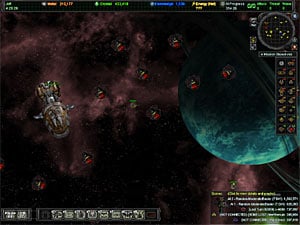
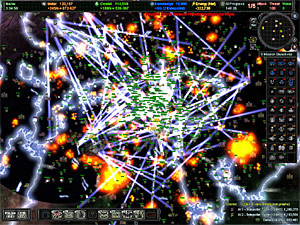
One of AI War’s biggest setbacks is its graphics, which offer very little in the way of eye-candy. That isn’t to say what is presented is terrible, it just isn’t what most are used to. The game is entirely 2D, and all the action is viewed from the top-down perspective, which is more of a stylistic choice based on the developer’s fondness of old-school gaming. AI War’s visuals are certainly reminiscent of games such as Continuum and SOE’s Cosmic Rift, but, despite the obvious homage to the classic 2D games of the past, they can sometimes hinder the gameplay.
Because AI War is about large scale battles between thousands of ships, it can be easy to get lost among them quickly. Many of the smaller ships such as the fighters, scouts, and bombers can get swallowed up and lost in a sea of larger ships, making it difficult to get a grasp on your tactical situation. Furthermore, when ships are floating around by themselves, as is the case with the engineers, locating them on top of an overly-colorful space background can be challenging. To its credit, AI War does offer a variety of helpful buttons and hotkeys to manage your ships in each planetary system, but it takes a lot of getting used to.
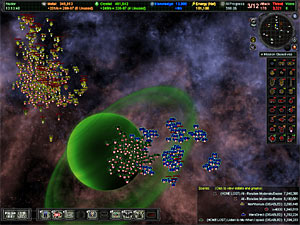
Additionally, the user interface, while providing a lot of depth to the gameplay and offering players detailed statistics on the game’s progression, can be difficult to navigate quickly when it matters. The large number of colors can be distracting at times and the need to hover over icons to get even the most basic information can be tedious. Of course, these frustrations vanish once a player becomes better acquainted, but be warned that AI War’s UI can and will challenge a newcomer’s patience more than your average RTS.
Visuals aside, the gameplay depth is where AI War’s focus shines. The standard RTS foundation, however, remains the same, with players needing to acquire and amass resources in order to produce more ships to use to attack and defend against the AI. From there, players are dumped into an expansive that can feature hundreds of planets ripe for colonization. These planets are then linked together by paths, on each end of which is a wormhole. AI War presents players with a simple objective, destroy the enemy AIs’ command ships. How exactly players decide to go about doing so is entirely up to them. Deciding which planets to capture or defend, which wormholes to place mines next to, and whether to focus on a specific type of ship are all decisions teammates will need to make.
In an attempt to ease the resource gathering aspect of the gameplay, AI War allows players to quickly setup resource harvesters with the click of a button. Moreover, the resource deposits surrounding each planet never run dry, which takes another worry off the player’s mind. While the metal and crystal require gathering, energy, which powers all the stations and defensive turrets, is finite. AI War doesn’t stray far from the RTS formula in this regard as the building of reactors is necessary. However, building too many reactors surrounding a single planet reduces the efficiency of the reactors, decreasing how much energy they yield.
In addition to metal, crystal, and energy, AI War also requires players to accumulate knowledge points, which are used to unlock upgrades. Knowledge points are gained by creating science labs, which continuously yield small numbers of points per second. To keep players from defending a single planetary system until fully upgraded, planets yield a maximum of 2,000 knowledge points each, so if players wish to continue upgrading, they’ll need to do some planetary conquering. All things considered, the resource gathering and economic gameplay in AI War is simplistic, but only in so far as it is easy to grasp, allowing players to focus on the core of the game’s fun: combat.
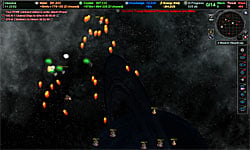
The sheer number of ships and defensive structures, which can be daunting when fully upgraded, provide players with a wide variety of tactical options with which to play. And, despite each ship and structure having detailed statistics such as armor, shields, weapon damage, firing rate, and movement speeds, AI War provides a quick Weak vs. and Strong vs. comparison to help players along. One notable gameplay element that is particularly interesting is being able to increase the power and efficiency of smaller ships that stay close to larger ships, proving that fleet diversity goes a long way in achieving victory.
While micromanagement of units is possible in AI War, it is clear that it isn’t necessarily the best way of playing. Instead, AI War sacrifices what many would refer to as strategic depth for tactical depth, meaning that giving individual orders to ships may not be as effective as deciding on where to locate your fleet in conjunction with a wormhole or a set of short-range turrets. Tactics such as flanking with a smaller, faster fleet are more likely to prove helpful than issuing all your cruisers to focus on a particular target. The AI is designed to let the player rest easy during combat by ensuring that ships don’t just sit idly by and be destroyed because they received a “move” order and not an “attack move” order, and it manages to do the trick.
AI War is also designed around longer-lasting games, with the shorter ones taking just about 7 hours to complete, depending on the difficulty settings, of which there are 13 grades of AI difficulty, ranging anywhere from rendering the AI comatose to making them appear to be on steroids. While this may seem rather unnecessary when compared to other RTS games and how they manage AI difficulty, for AI War it is not only justified but an important gameplay mechanic that extends the game’s replayability.
It is important to note that the controls are very typical of your modern-day RTS game. Dragging is still a common way of selecting and grouping units together, a zoom feature allows players to quickly assess situations across entire planetary systems, and switching between keys, fleets, and structures can be managed using hotkeys. Conversely, there are some minor oddities that can cause frustrations. For example, the ships use wormholes to fly between planetary systems, but simply selecting a ship and clicking a wormhole doesn’t get the job done. Instead, players must select their ships and then hold the left control key while clicking the right mouse button to make the ships interact with the wormhole. On top of that, holding the left control key and then left-clicking moves the player’s camera to the other side of the wormhole, but not the ships. Why ships cannot move by selecting them and simply right-clicking the wormhole seems strange. Nevertheless, these types of annoyances are few and far between.
The multiplayer features of AI War also allow players to enter and leave existing games as much as they want without affecting it too much. Being able to start and finish a saved game with an entirely different team is a huge plus for AI War considering even the shortest games take close to an entire workday to complete – time that many people cannot dedicate without stopping.
AI War certainly doesn’t offer the bells and whistles that come standard in most mainstream RTS games. Extras such as in-game leaderboards, matchmaking systems, chat rooms, and buddy lists are all MIA. It also won’t blow you away with impressive, 3D graphics that tear a hole in the meaning of “next-gen.” With that said, don’t be fooled by the lack of features, as the game oozes fun and teaches us once again not to judge a game by its art design. AI War: Fleet Command provides the kind of gameplay depth rarely seen in today’s mainstream RTS offerings, and it does so with one dimension tied behind its back.
RATING OUT OF 5 RATING DESCRIPTION 3.0 Graphics
Stylized 2D visuals make for a classic feel, but do little to capture the intensity the gameplay is attempting to create. 3.5 Control
Mostly-standard RTS controls reduce the overall learning curve, but a few differences cause minor frustration. 2.5 Music / Sound FX / Voice Acting
The music suits the game well, but it can become repetitive and distracting quickly. Sound effects do the job, but they don’t complement the on-screen action as well as they could. 4.5 Play Value
Standard RTS gameplay, trimmed and reworked, coupled with advanced AI, and a focus on cooperative play, maximize the depth and fun, while increasing the replayability. 3.8 Overall Rating – Good
Not an average. See Rating legend above for a final score breakdown.
Game Features: