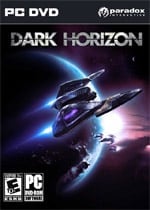
It’s Not Pretty, it Just Looks That Way
I can’t help but feel that Dark Horizon was found behind the fridge in an abandoned lunchroom at a bankrupt development studio. Discovered by the new game-publishing tenants, this dated and hackneyed game was thrust into the marketplace as a no-lose proposition. Any monies generated by this “fridge freebie” would simply be gravy. Unfortunately, it’s making me stew.
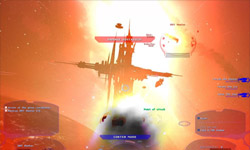
Dark Horizon is so average I can’t help but wonder if the developers are aware of any other space shooters on the market? It’s not clear exactly what Dark Horizon is, although there are plenty of hints at what it wants to be. There are elements of space sim, space shooter, strategy, and even RPG features. Sadly, none are fully realized. At best, Dark Horizon is an arcade shooter. The RPG elements are confounding and do little more than add useless details to the convoluted storyline. Missions are linear and predictable. Ship customizing is offered but it’s very basic, offering very little in the way of strategy. Although you start the game taking orders from a commander, and eventually work your way up to being the boss, at no time do you ever feel in total control. And that’s just not very much fun.
In the future, the universe is at the mercy of a seemingly omnipotent force called the Mirk. It’s not just a race of quirky, evil aliens. It’s more like a universal plague, and you’re actually infected with it. The only thing that can destroy the Mirk is an intense particle beam weapon called the Light Core. This weapon is still being constructed, so you’ll have to defend your stations against attacks until it can be brought into service.
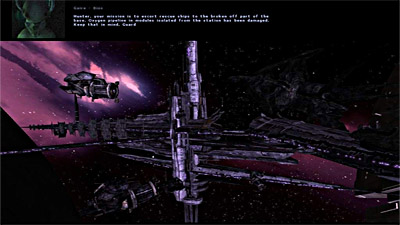
Throughout the game, you’ll be subjected to cutscenes, conversations, annoying radio chatter, and epic chunks of text that turn the storyline into a novel. It’s the only area in the game that displays any actual depth, but has virtually no connection to the gameplay. There’s everything from historic archives to read through to dream analysis. It’s interesting, but it starts to get old once you realize that you’re kind of being tricked into a false sense of depth, as you’re always thrown into the same arcade-style combat.
For an arcade-style game, the control system is not immediately user-friendly. There’s a good tutorial that shows you the basics and, of course, the hotkeys you’ll have to memorize. The keyboard and mouse don’t have a symbiotic connection to each other. It’s more or less a means to an end, and one that you’ll get used to after about an hour, but it just doesn’t feel natural. Some of the missions are on-rails, where it’s basically drive-by shooting; the only thing you have to worry about is deploying the weapons systems at the right time. But there are some missions that require more skillful manipulation of the craft, and that’s not easy. Dog-fighting requires you to change direction abruptly, including complete 180s. You’ll often run out of scrolling space moving the mouse in one direction, causing you to pick it up and move it back quickly to increase the scrolling distance. Make sure you’ve got a lot of room to move that mouse around in. To add to the frustration, there are no mid-level saves. Thankfully, the missions don’t last more than ten minutes.
Ship customizing is limited, but it’s a diversion from fighting, and one that artificially makes you feel like you’ve got some control. You can choose various shields, hulls, and weapon systems.
Or, if you would rather not fuss over the placement of a missile launcher, you can just let the CPU do it for you. It places things in a logical manner, where you might be tempted to overcompensate for something resulting in an unbalanced ship. Whatever weapon system you choose, you’ll never have enough ammo. In later stages, you can custom-combine these systems by melting down resources that you acquire.
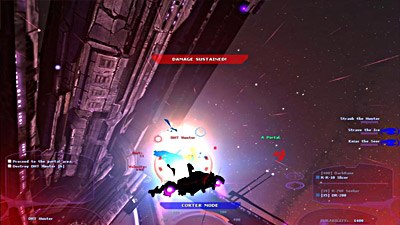
There are two main combat modes: Stealth and Corter. By reducing the temperature of your ship, you are able to pass through enemy territory undetected. However, you have to travel at a very slow speed with the weapons only functioning at a fraction of their capabilities. As the ship becomes hotter, due to deploying your weapons or holding down the L key, you will enter into Corter mode, where you are at peak power in terms of speed and weapon deployment. The weapons shoot faster and more powerfully, and the bursts of speed will allow you to get out of some tight situations. This comes at the expense of your shields, so you’ll want to make sure you have an escape route in sight or you’re going to become Swiss cheese.
As the commander, you’ll find your squad is little more than a bunch of amateurs. They don’t perform very well on their own and they don’t follow orders very well either. A particular strategy would be to use some of them as decoys, or even as expendable crafts that would take the heat off of you. But they aren’t interested in getting killed, and the enemy A.I. refuses to take their eyes, and laser missiles, off you.
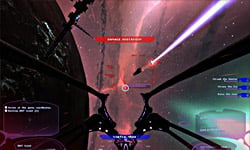
Graphically, the game looks good with objects rendered in 3D, shaded to display their relative position in space. The HUD will also help you keep track of your position and that of enemy ships, although not all ships are on the radar and the dark ones can be virtually impossible to see. The explosions are very colorful; almost flamboyant. The same can’t be said about the sound effects, which are weak and repetitive. Bad voice acting, repetitive music, and weak-sauce weapon blasts begs you to override the audio with your home stereo system. And let’s not forget about the lack of any multiplayer modes. It’s possible to complete this game in one day, with no reason to replay it.
Dark Horizon is a game that should be seen, not heard. Whether it should be played depends on just how empty your life is.
RATING OUT OF 5 RATING DESCRIPTION 4.5 Graphics
Great-looking ships. Beautifully rendered 3D space arena. 2.8 Control
The system feels awkward and unnatural. Lots of lengthy mouse scrolling. 2.0 Music / Sound FX / Voice Acting
Weak sound effects, poor voice acting, and repetitive music. 2.4 Play Value
Arcade-style play doesn’t fit with the story, and there’s no multiplayer. 2.6 Overall Rating – Average
Not an average. See Rating legend above for a final score breakdown.
Game Features: