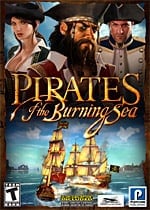
You’re in for the long haul, and possibly a keehaul…
Until I played Pirates of the Burning Sea, I was not sure what keelhaul meant, but it always sounded like something I didn’t want to experience first hand. “Scurvy dog,” “swashbuckler,” “mizzenmast,” are all part of the pirate lexicon. Pirates of the Burning Sea will introduce you to these terms and let you experience them virtually first-hand as you take part in a world that existed hundreds of years ago.
This massive online multiplayer game is not meant for cheap thrill seekers. This is a thinking man’s game, one that offers plenty of adventure with the requisite economics. It’s deep, fun, loaded with action, and has more depth than you can possibly imagine. It’s all combined to give you months, if not years, of playability.
Pirates of the Burning Sea is all about sugar and spice and everything that’s not nice in relation to 1720s. The sugar and spice is a semi-metaphor for the commodities that will be traded, bought, sold, and plundered. As a pirate you have a mandate to invade ships and steal their goods. But as exciting a life as that sounds like, you don’t have to play as the bad guys. You will have your choice among playing as the English, French or Spanish. As any of these factions, you will be concerned with amassing as much fame and fortune as you can muster. There are several ways to accomplish this. You can start a respectable business and become a merchant or you can become a despicable rapscallion and give everyone the business. The choice is yours.
Taking place in the Caribbean, all of the main ports of call are under the control of one of the European factions. Controlling the port is key to the control of the entire area. This is where you begin generating revenue and building up your defenses. Pirates cannot control ports, but they can do so indirectly by attacking ships near the entrance. Such actions destabilize a port, making it less inviting for ships to conduct business. At the same time, the plundering builds up the pirates’ coffers, giving them more power.
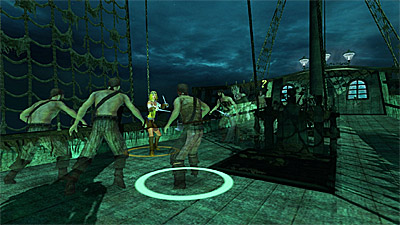
Pirates of the Burning Sea contains many RPG elements. Among them is the ability to level-up your character by performing various missions. These missions are more interesting than the standard fetch quests, often involving combat and treasure hunting. The main thrust of the game is economics. That may sound more clinical than fun, but in fact it’s much more fun than any study or lecture in economics that I’ve experienced. Since the game is a massive online multiplayer, the gameplay is designed to last for months, possibly years. Now, many of us already know the inherent dangers of this type of design. Eventually they bog down through repetition, and/or players have leveled-up to ridiculous levels and can beat the living crap out of you before you even get into the game. While I can’t guarantee that Pirates of the Burning Sea will never get redundant, there are some well-designed safeguards to keep it fresh and exciting beyond the shelf life of the average massive online multiplayer.
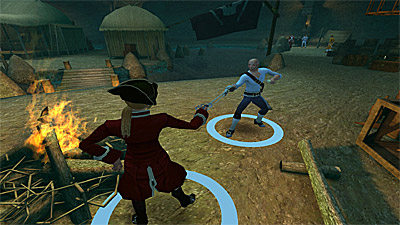
As characters level-up, they don’t necessarily become stronger. There aren’t a lot of combat moves to begin with and only a few special attacks. Combat comes in two forms: Hand-to-hand and ship-to-ship. The melee (or hand-to-hand) combat consists of guns and swords. What’s a pirate game without swordplay?
You can stab and slash your enemies or shoot them with a musket. Different styles of fighting range from dirty tactics to elegant swashbuckling moves that would make Errol Fly proud. Instead of increasing skills in any of these areas, the level-up system gives you better balance. Having better balance gives you more footing during battles. This is especially more evident when you’re flanked by enemies that can make you very unsteady and prone for a piercing. Keep in mind that you’re on a boat, and there are not very many places to run and hide should you find yourself in trouble. Personally, I find the whole balance thing a little on the weak side. It just seems kind of arbitrary, as though the developers couldn’t think of anything else. It’s just not very exciting, but at least it does tackle the issue of players getting too powerful for newbies to defend themselves against.
Not imposing a level restriction among players means that virtually everyone can interact immediately in this world. Players that do gain more experience will eventually reach a level that will give them access to larger vessels. Of course these vessels are the objects of everyone’s desire, but you’ve got to work your way up in order to become captain of one. Only the Europeans will be allowed to command such a ship, but the operative word here is “allow.” The pirates can take these vessels by force if they have the ability.
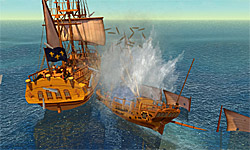
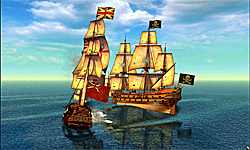
There are lots of ship battles in this game. Fortunately there are many different levels to the ship combat such as the number of ships involved and the types of ships and weapons. In an effort to give newbies the ability to confront more experienced characters, it’s possible for them to unite as a fleet of smaller vessels to attack larger Galleons. These smaller boats are more maneuverable and more difficult to target.
In ship combat, you want to disable the ship not destroy it, since you’ll want to loot it or steal it, or both. The more damage a ship takes, the more difficult it will be to control it. Taking out the sails is a good strategy. Once the ship is disabled, it’s time to board it. Here you will have to engage in melee combat with the enemy crew. Some battles can be won quickly if the captain can be captured. Other times you might be able to dispose of most of the crew by firing shrapnel from your cannons before you board.
The ships come equipped with large cannons, which can be directed at enemy vessels, but you have to keep in mind that your boat is essentially a sailboat, so you have to take the direction of the wind into consideration. This could leave you open to attack from different sides. There are plenty of variables to consider.
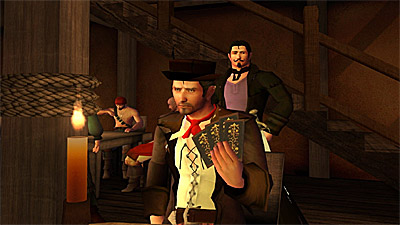
Commodities for sale and trade will be produced by the various factions. These goods which include rum, spices, and weapons, to name a few, are manufactured with raw materials that are gathered. The process to manufacture these goods is complex and detailed. If you want to make rum for instance, you’re going to need all of the ingredients such as sugarcane and molasses. Then you’ll need a distillation plant, oak barrels, and a warehouse to store the finished product in. This commodity-production system is built over time, so it’s not as daunting as it sounds. It’s another example of the developer’s commitment to keep the gameplay fresh for as long as possible since there are so many things to produce.
The oceans are expansive, the characters are lifelike, the ports and towns are spacious with lots of details. Non-playable characters wander around through the streets helping to create a believable, realistic atmosphere. The Galleons are impressive. They are majestic, massive, and somewhat intimidating. They are rendered with great detail, from the wind-blown mast to the random knots on the wooden deck. Ambient sound effects enforce the realism. You can hear footsteps of characters as they approach from offscreen. The explosions of the cannons is sure to rattle your subwoofers.
With Pirates of the Burning Sea, you’re in for the long haul, possibly a keelhaul. The premise is fueled by historical accuracy, so there is a lot of realism to the gameplay, yet this isn’t just a game for nerds. It’s deep, but the curve is gradual, which will accommodate a wide range of gamers. Alright now matey, you’ve heard enough, now off we ye.
RATING OUT OF 5 RATING DESCRIPTION 4.7 Graphics
Great attention to detail. Very colorful and expansive. 4.8 Control
Based on the WoW interface, the control system is about as easy to use as can be expected. 4.6 Music / Sound FX / Voice Acting
Good voiceovers, ambient sound effects, and appropriate music. Never overdone. 4.9 Play Value
Lots of depth. Easy to get into and should last a long time. 4.8 Overall Rating – Must Buy
Not an average. See Rating legend above for a final score breakdown.
Game Features: