Cheesy in a Good Way
On the heels of Telltale Games’ highly entertaining point-and-click adventure game treatments of the anthropomorphic freelance police duo Sam & Max and the bizarre antics of Strongbad and his Cool Game for Attractive People posse comes another episodic gaming series packed with humor and personality. Series after series, Telltale has proven adventure games are alive and well, and the downloadable episodic format is clearly a growing platform for the genre. Featuring the renowned, cheese-loving British inventor and his mute-but-intellectual pooch, Wallace & Gromit’s Grand Adventures: Fright of the Bumblebees kicks off another volley of bite-sized monthly adventure gaming.

Despite their stop-motion clay animation roots, Wallace and Gromit are no strangers to the video game world. Since their debut in a themed mini-game collection on an interactive CD-Rom game back in the mid 90s, they’ve starred in a handful of games based on classic animated shorts and their semi-recent feature film. In Fright of the Bumblebees, the first of four upcoming installments in the Wallace & Gromit’s Grand Adventures series, the pair may be ill-equipped to deal with dicey new business operations and a swarm of miscreant worker bees, but they deliver amply on the promise of goofy and interesting gameplay.
Other than his borderline obsession with all manner of cheeses, Wallace is known for his over-elaborate and wild inventions – the bulk of which typically function in disastrously unintended ways. With the monthly bills piling up, it helps little when his new cheese-sniffing robotic mouse contraption goes haywire and rampages through the local grocery store. To square up his debt to the shopkeeper, Wallace decides to kick his basement honey making operation into high gear and agrees to produce and deliver a ridiculous amount of the sweet, sticky stuff by the end of the day. However, a crackpot scheme to locate enough flowers to feed his hungry bees backfires, resulting in insects of unusual size cavorting around town and terrorizing local citizens. Putting a stop to the buzzing menace is an appropriately silly project that requires the duo interact with some of the town’s quirky residents and piece together obscure solutions to numerous puzzles. Wallace and Gromit fans will find the humorous story and other shenanigans are on par with the quality amusement found in the animated shorts.
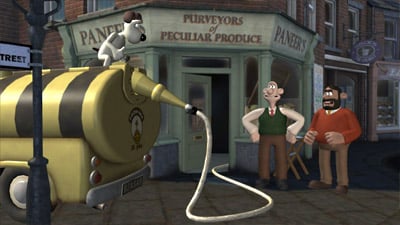
Per the usual, Wallace is rather clueless and unknowingly must rely on his pal Gromit (the brains of the operation) to pull things through. You’ll switch back-and-forth between controlling the two characters at different points in the adventure as the plot progresses. Each character offers a slightly different perspective of the situation. Wallace is funny and meek but rather oblivious and a little daft; Gromit doesn’t talk at all (he lacks a mouth and communicates only through facial expression and gestures) but is clearly brighter than his human master. They’ll react differently to the same interactive elements in various rooms, which means hunting for clues and items yields different result depending on the current character you’re playing. This stretches the exploration in the game’s three main settings a tad further, since new events will happen upon revisiting rooms further along in the story.
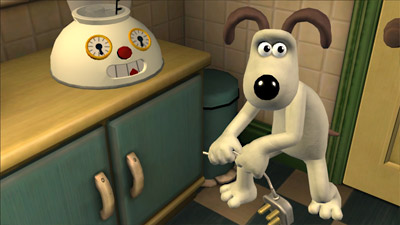
Deviating slightly from the standard point-and-click setup (due to plans for the eventual launch of Xbox 360 and PS3 versions of the game), controlling the movements of Wallace or Gromit is done independently of the hotspot selection. The WASD keyboard keys move your character towards and away from the camera and left and right. The exact direction you’ll move changes in relation to the static camera angle for a specific area, which automatically pans and changes frequently as you move around.
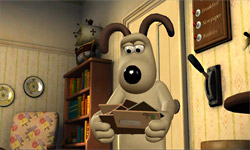
This can sometimes be a tad disorienting when transitioning from one area to another, since you may find the directions have suddenly switched up unexpectedly. Interacting with nearby objects and examining items is still done with the mouse button. Separating the movement from the hotspot clicking was a questionable decision that was clearly a result of designing the game with controllers in mind. While it works reasonably well on the PC (and will surely be pulled-off fine on consoles), it’s more awkward than it needs to be. As the saying goes: if it’s not broken, don’t fix it.
Many of the puzzles in the game involve scouring rooms for usable items and figuring out where to use them elsewhere in the game. Through most of the adventure your inventory never gets particularly large, and most of the things you pick up are used rather immediately. Wallace’s inventive nature and the peculiar gizmos you’ll come across around the house make for some fairly unusual combinations. There are also a few different kinds of challenges thrown in at various points to provide variety, particularly towards the end of the episode.
Presentation-wise, Fright of the Bumblebees nails the spirit and personality of the animation series perfectly. The cartoonish graphics have just the right amount of shine and texture to closely capture the look and feel of the original clay animations. The animations themselves are more fluid than the claymation, but they are very true to the original style. Digital recreations of Wallace and Gromit’s home and neighborhood are spot on, and all of the locations are nicely detailed. Unique camera angles keep things fresh too. Rather than the traditionally static front-view found in many adventure games, the camera angles fluctuate from numerous perspectives and angles. Voice work is also a big draw. Sadly, it’s often drowned out by slightly louder than necessary music. Without turning subtitles on (there’s no menu option to adjust the music and dialogue volumes separately), you’ll have to strain your ears to make out some of the thick British accents.
On the whole, Fright of the Bumblebees is an excellent starting point for the episodic series. Wallace and Gromit are just as charming as ever, and their first episodic romp left us looking forward to seeing where Telltale will take the two in future episodes. Clocking in at several hours of solid playtime, episode one is a relatively short endeavor, but the content is brimming with quality.
RATING OUT OF 5 RATING DESCRIPTION 4.0 Graphics
Excellent visual presentation improves on and stays faithful to the clay animation classics. 3.5 Control
While it’s an interesting change of pace, splitting somewhat from the traditional point-and-click format isn’t as functional on the PC as it could be. 3.7 Music / Sound FX / Voice Acting
The voice acting is brilliant, but it’s overpowered by the musical volume. Separate volume adjustments next time… please! 3.7 Play Value
Short, sweet, and highly entertaining. 3.9 Overall Rating – Good
Not an average. See Rating legend above for a final score breakdown.
Game Features: