A Bond By Any Other Name
Bond games have a tumultuous history. While GoldenEye 007 on the Nintendo 64 was one of the console’s seminal titles, played to this day in college dorm rooms across the country (usually between rounds of Mario Kart 64), subsequent attempts at shooters in the Bond universe have been above-average at best, whether they went the first-person or the third-person route.
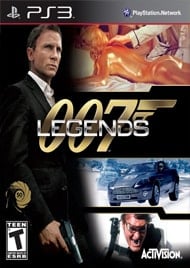
With his fiftieth anniversary and twenty-third movie coming up, though, Activision (which currently holds the Bond license) has decided that it’s time to try again, releasing 007 Legends as something of a playable love letter to the super-spy’s oeuvre. As such, rather than create an original story for the game, or adapt one of the past Bond movies, 007 Legends draws inspiration from the agent’s entire history, with levels representing Goldfinger , On Her Majesty’s Secret Service , Licence to Kill , Die Another Day, and Moonraker .
A sixth chapter, corresponding to the upcoming film, Skyfall , is slated for release after the movie hits theaters, as free DLC.
The eagle-eyed Bond fan, or those with good memories, might have noticed that there are six chapters (if we include the DLC), corresponding to the six different actors who’ve played James Bond. In fact, each actor is represented by one of their films (in Lazenby’s case, his only film) in the level list, with Daniel Craig to join his predecessors when the Skyfall DLC touches down. That isn’t to say that you’re switching between Sean Connery Bond and Pierce Brosnan Bond, though.
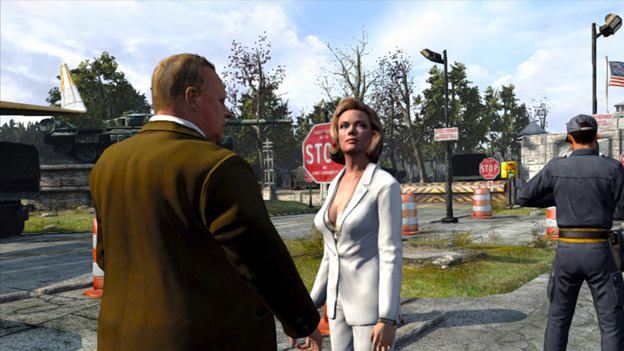
007 Legends makes an effort to tie the entire Bond narrative together by inserting the current actor, Daniel Craig, into each of the previous movies (it’s worth noting that he doesn’t represent the only casting change, the most obvious of the rest being the white-washing of Die Another Day with a Caucasian Jinx, in lieu of Halle Berry). He brings with him his grittier, more grounded take on Bond, with a pervasive “serious business” feel throughout the game. This is likely due, in part, to the framing story of the campaign, which involves Bond flashing back over key moments in his life as he floats underwater, shot and drowning.
It’s for this reason that the campaign seems to hit only on the high-action notes of most of the films it tackles. Gone is almost all downtime, rarely is Bond’s voice actually heard doing anything other than giving orders or insulting a villain. He’s snappy and bitter, his no-nonsense attitude runs dry by the third film. This is one of the downsides to such a sprawling, disconnected story. It’s like a picaresque novel in audio-visual form, mostly unattached stories linked together by the protagonist and some of the other characters who appear within, graced with that bare hint of a bigger tale told by the framing story, left unfinished with the promise of more come the Skyfall DLC.
Yes, the game ends without resolving its original conceit. Does Bond survive? Is the scene in which he is shot and drowning excerpted from the upcoming film? I don’t feel that it’s spoiling it to tell you that the expected resolution hasn’t yet arrived and is promised in weeks following the film’s release, but now buyer beware: By definition, you’re getting an incomplete game.
So the levels are disjointed and provide little in the way of context, but those to whom this game is going to most strongly appeal—the die-hard Bondians—will know how each tale goes. They’re fairly iconic movies for the most part. It’s disappointing to get only snippets of the moments that truly differentiate Bond from the shooter heroes to which gamers have grown accustomed, but that doesn’t change the greatest positive element to arise from 007 Legends’ structure: level variety.
There’s something to be said for the level design, actually. It’s mostly linear, but offers the player more of an opportunity to explore than in most modern shooters, which allows the player to feel as though they have a bit more agency in how things go about. Perhaps Bond being mostly solo or in a pair, rather than saddled with a full retinue of soldiers, also contributes to this sensation.
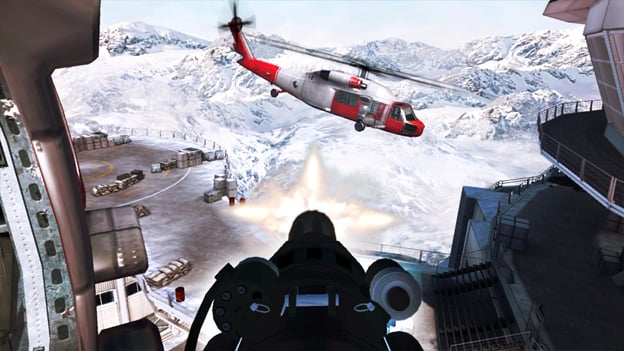
With five completely different plot-lines, Bond finds himself in the jungles of South America, in the vault of Fort Knox, amid ice caps and space stations alike. It makes for a visually distinctive title, with each movie handily possessed of its own feel. The plots of them escalate as well, growing from financial terrorism to full-scale genocide.
It’s perhaps a bit unfortunate, then, that the means to stopping them, and progressing through each of the distinct levels, is generally so similar. The vast majority of the game is centered around its shooting action and its stealth mechanics, the former being pulled almost untouched from Call of Duty while the latter is enjoyable, but suffers from the standard pitfalls of first-person stealth.
Gunplay is as responsive and fast-paced as you’d expect in a Call of Duty title, but this is actually a bit disappointing. Bond movies are all about the drama, not the protracted gun battles. Even when there is an action sequence, though, they skew toward the dramatic rather than the realistic (yes, even in the Daniel Craig films), and swarms of enemies combined with that all-too-familiar quick-scoping play-style makes for an experience that’s out of place in a Bond game. Melee, at least, has been altered in a way that makes it distinctly more cinematic, with most melee attempts resulting in one of a few quick disarm and takedown animations, but the tone of these—typically just knocking out an enemy on the spot—clashes with a game that offers sprays of blood when bullets strike enemies and some extremely pointed and violent deaths for major villains (though, honestly, what is it with Bond tossing people out of airborne things? Of the five chapters, four involve the main villain being thrown or forcibly ejected from a flying or suspended vehicle).
In the end, though, the combat makes for an all-too-easy time slaughtering waves of enemy forces, which are sure to come when you inevitably fail a stealth section.
Though, for all the times you’ll be failing them, cursing the screen wildly, the stealth is possibly the best part of 007 Legends. Before you’ve been detected, melee takedowns are a silent strike and silenced weapons won’t alert enemies as long as they kill on the first shot. Enemies can spot you, hear you, or see your handiwork and raise the alarm if they’re sufficiently aware (there’s an onscreen visual indicator of just how alert any given enemy is). Corpses spotted by a level’s cameras will also raise the alarm, though these also have visible cones of detection.
Really, 007 Legends does a lot that tries to offset the usual problems with first-person stealth. There are the aforementioned visual indicators of awareness, and Bond’s wristwatch doubles as a radar device, which can lead to a satisfying rhythm of planning one’s move followed by an exhilarating run across the room and out of the enemy’s sight. In the end, these segments can’t get over the inherent issues of first-person stealth—that being a lack of a direct, easily interpreted indicator of just how you’re positioned. As such, most stealth segments devolve into hectic gun battles.
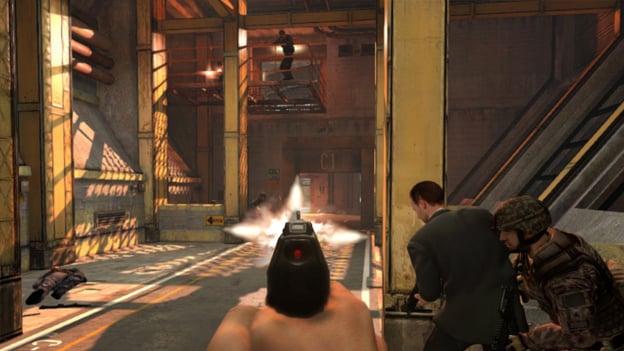
Except the forced stealth segments. Those devolve into dozens of alert-based restarts, because being spotted is instant failure. They’re the worst part of the game, by far, which is surprising given how fun playing a crafty, well-hidden Bond can be.
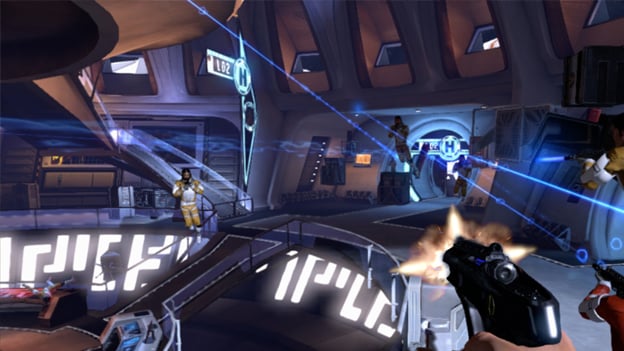
Other than these, there are occasional variations in the gameplay, some of which are one-shots (such as a couple of driving sections and a skiing bit) while others are recurring. There’s the pointlessly simple fisticuffs minigame, which consists of following onscreen prompts for about thirty seconds to put a character out of their misery in hand-to-hand combat. Investigation sequences involve using Bond’s smartphone to hack electronics or unveil his quarry’s fingerprints on key parts of the environment, exposing hidden switches and whatnot. It’s usually busywork, but there’s the occasional fuse box puzzle, which offers an enjoyable, color-coded challenge on the half-dozen occasions it crops up. Lastly, there’s an extended sequence in Moonraker that takes place in zero gravity. The controls for this work surprisingly well and, as absurd as it is, it somehow manages to prove immensely enjoyable.
007 Legends also has a few elements designed to expand its longevity. Every mission has secondary objectives, more of which become available on higher difficulties. It’s a throwback to GoldenEye, though the objectives this time out are wholly optional and are very easy to miss (often, I didn’t even realize I had any secondary objectives to fulfill), to the point of seeming hopelessly out of the way. There are also challenge missions one can undertake, which are graded score-challenges based on altered versions of levels from the campaign. These are fairly interesting and very demanding. Lastly, there’s the multiplayer.
I can’t say too much about the multiplayer, though. It’s all competitive, divided into free-for-all and team games. There are a few deathmatch modes and some capture the flag variants, which I’m sure would be very interesting, but finding someone playing anything other than basic deathmatch (which does come with the perk that one can play as iconic franchise characters) is next to impossible. So, yeah, the multiplayer is kind of a bust.
The other little touches in the game, such as the character and organization bios and the upgrade system, are kind of neat (and the weapon upgrades add a lot of customization options to the gameplay), but they don’t do much to combat the somewhat stale core gameplay and the helter-skelter story. The game is certainly fun, mind, and having the Bond license in there will make it all the more pleasurable for those who are longtime fans of the character, but I can’t help feeling that, in the end, the game is a mass of wasted potential.
RATING OUT OF 5 RATING DESCRIPTION 3.0 Graphics
Neither offensive nor spectacular, the graphics don’t get in the way, but also do little to wow. The variety in the game’s level design, however, is impressive. 4.0 Control
Tight and intuitive, for the most part, shooting is quick and responsive. Stealth can actually be fluid and a lot of fun. 3.5 Music / Sound FX / Voice Acting
It’s a Bond soundtrack, and many of the voices are intact, but it’s lacking Daniel Craig. His soundalike often seems almost upset to be there. 2.5 Play Value
Beyond the challenge missions, there isn’t a lot to keep one coming back. Secondary objectives are wholly optional and largely uninteresting while the multiplayer is dead on arrival. 2.8 Overall Rating – Average
Not an average. See Rating legend below for a final score breakdown.
| Review Rating Legend | |||
|---|---|---|---|
| 0.1 – 1.9 = Avoid | 2.5 – 2.9 = Average | 3.5 – 3.9 = Good | 4.5 – 4.9 = Must Buy |
| 2.0 – 2.4 = Poor | 3.0 – 3.4 = Fair | 4.0 – 4.4 = Great | 5.0 = The Best |
Game Features: