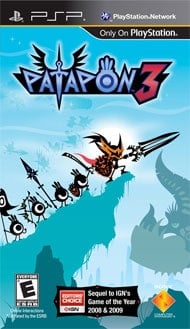
The Patapons Have a Hero
In all my years of gaming I’ve never seen a breath of fresh air quite the likes of the original Patapon. When it debuted on the PlayStation Portable back in 2008, the entire system felt rejuvenated. It wouldn’t be long before the PSP returned to being a barren wasteland devoid of good games, but for that moment it was fresh and full of possibilities.
Patapon was a beautiful, innovative, inventive, and just plain fun adventure unlike anything anybody had ever seen before. It was unthinkable that a company as huge as Sony would be willing to take a risk on a title like this. It was even more unthinkable that the series would become a success in North America, and actually be one of the marquis series the PSP had to offer.
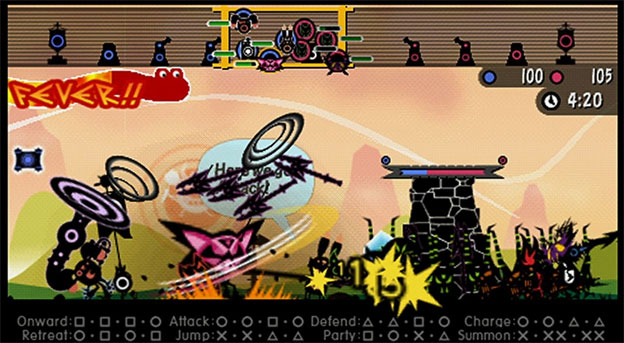
Now we stand here today as the third game in the series is being released. I doubt anybody would have thought it possible. While Patapon 3 remains a fundamentally sound and fun game, a lot of what made it so great three years ago has been lost. Its sense of pure personality and other-worldliness has been lost in favor of some trendy design choices that somewhat cripple the experience.
If you’re a Patapon veteran, you may not mind this so much. A few things will be annoying, such as the game’s newfound attempts at humor, which have patapons calling each other “dude” and other self-aware fourth-wall breakers. Patapon 3 feels less like its own world than it does a puppet show with its creators’ hands clearly visible pulling the strings.
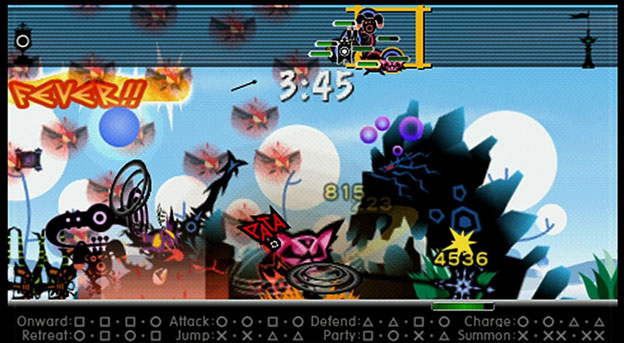
The creators have tried to popularize the series a bit. The most likely reason is because Patapon 2 failed to achieve the success of its predecessor. So they decided to mix things up, and the series is worse off for it. The game is fun in its mechanics, but vapid in its sense of place and personality. Its subdued personality has been replaced by bad jokes and ridiculously flashy anime-style cutscenes.
Newcomers to the Patapon series would do well to go back and play the still-excellent original Patapon. Starting with Patapon 3 will likely cause everything that made the game great seem completely invisible to the newcomer. Veterans of the series, however, will be able to ignore the odd new presentation, and focus on the gameplay. The gameplay in this iteration is vastly simplified over Patapon 2, which may upset some fans who loved the immersion of having to go hunt for creatures if you needed their meat or bones for an upgrade (sometimes at very specific times of day).
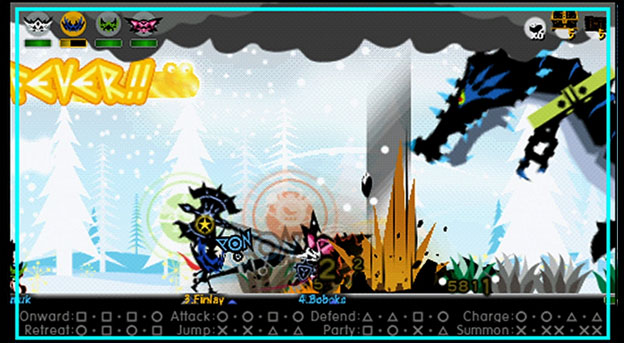
Now you simply get a bunch of unique items after each mission. If you need to upgrade your equipment, you just scrap some of the useless stuff and pump the money you receive for it into your best gear. It’s not deep or complex at all, but it’s satisfying. It should do more good than harm. There are probably more people annoyed by Patapon 2’s insistence on grinding than will miss it.
The gameplay itself has gotten some changes as well. Most gamers, I think, are familiar with the Patapon formula at this point, but it bears repeating. The four face buttons are different “drums” that make unique noises (Pata, Don, Chaka, and Pon). You string those sounds into four-beat songs that instruct the patapons in your army on what to do. Want them to attack? Pon Pon Pata Pon! Want them to retreat? Chaka Chaka Pata Pon! There are many different songs to choose from based on what’s best at that specific time. If you keep up the beat and don’t miss anything, then you’ll go into “fever” mode, which amplifies their abilities.
Patapon 3’s biggest success is that it introduces some new gameplay into the stalling franchise. Without giving too much away, one such game has the player competing against the computer in a tug of war-style game. The two armies clash and fight for position on a 2D battlefield. If you push the army back you can gain locations on the battlefield that give you points towards victory. Those points also spout cannons that help you defend that position. These kinds of new gameplay varieties are most welcome, and really help keep the experience fresh.
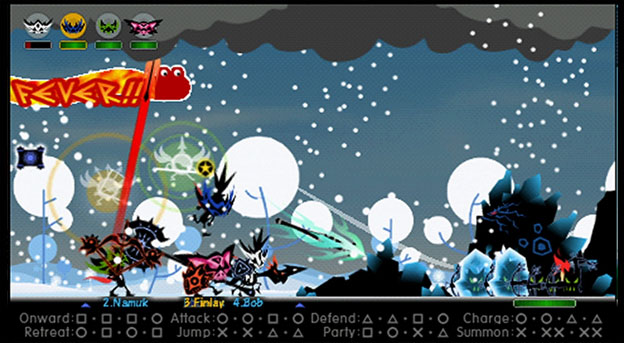
Unfortunately, the same can’t be said for the new visual style Patapon has adopted. New players won’t notice, but veterans will see how far the series has strayed from its original awesome art. At first Patapon was what we’d call minimalist. It was almost entirely black and white with orange backgrounds. The result of that was that it made even the tiniest bit of color stand out. When you got a neat piece of gear or special Patapon, it looked amazing by contrast. By the end of the game your army was shimmering. It was a fantastic technique. In Patapon 3, the game is pretty, but color is everywhere. It’s visually pleasing, but it loses everything that its predecessor gained by being restrained.
The audio remains great however. The restraints have been nearly entirely lifted on how close you need to be to “on rhythm” to continue the song. Previous games were very strict and a momentary lapse of concentration could cause you to fail. Patapon 3 is much easier in that regard. Plus the game does an even better job of letting you know that you’re off rhythm. Subtle sound changes in the drums hint that you’re not quite on the beat.
Overall it’s hard to say that this new direction is a positive one for Patapon. Again, I’d like to stress that if you’re a fan of the series, there’s no reason to shy away from this game. It’s a cheap ($20) game with an awesome formula, but that doesn’t mean it stacks up to the original games. The big question here is whether you’re a Pata-veteran or a newcomer.
If you’re new to the series, you definitely want to start at the beginning. The gameplay is almost unchanged, and it’s a far better, more immersive game. If you’re veteran, then you’ll be able to look past some of the annoying window-dressing in order to get to the thankfully largely unchanged core gameplay.
The question of whether Patapon 3 is a good game is largely a question about the process of reviewing a video game. If you’re looking for advice on whether this game will give you your money’s worth: yes, it will. If you’re concerned with the craft of making games and iterative design, then Patapon 3 is an almost complete failure whose only successes are carried over from past games.
RATING OUT OF 5 RATING DESCRIPTION 3.8 Graphics
The Patapon black-and-white color scheme is more varied this time with more plentiful colors, but I’m not convinced that’s really a good thing. 4.5 Control
Patapon still controls like a dream, and is just a joy to play. 4.3 Music / Sound FX / Voice Acting
The mere sound of the Patapon’s voices as they sing their song clues you in to how your rhythms are doing. Tons of great sound work. 3.5 Play Value
Patapon 3 is here, but it’s lost something since the second game. There’s a missing sense of personality, which was a huge part of the appeal of Patapon 1 and 2. The core game is still great, and there’s plenty of good material, but the first two games are undeniably better. 3.7 Overall Rating – Good
Not an average. See Rating legend below for a final score breakdown.
| Review Rating Legend | |||
|---|---|---|---|
| 0.1 – 1.9 = Avoid | 2.5 – 2.9 = Average | 3.5 – 3.9 = Good | 4.5 – 4.9 = Must Buy |
| 2.0 – 2.4 = Poor | 3.0 – 3.4 = Fair | 4.0 – 4.4 = Great | 5.0 = The Best |
Game Features: