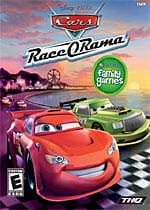
Disney and Pixar’s animated movie, Cars, celebrated its third birthday this past June, and with no sequel in sight, one has to ask: Why are we still getting games based on this license? We may never know the answer to that question, but THQ has, nevertheless, put the pedal to the medal with another racing adventure for Wii and PS2. Does Race-O-Rama have the turbo to charge fans up?
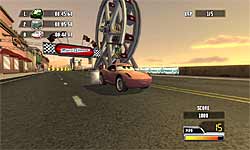
If there’s one thing that can be said for Cars Race-O-Rama, it’s that it sure isn’t light on content. Players can journey through a fully realized story mode, as well as dabble in a host of arcade options with a friend. Everything from circuit races to off-road, monster-truck derbies and kart competitions is on the menu here, and though there is a healthy portion of filler, there’s also a surprising amount of fun content under the hood.
In story mode, the gameplay is presented in a sort of open-world scenario, where you’re free to drive around virtual towns and landscapes, cherry out your car, and take on optional challenges. Star challenges move the story along, and after completing a handful of races, you’ll move on to another area of the game world. There isn’t a whole lot going on in any one particular area, but there are some trinkets to be found in various nooks and crannies of the map.
The star challenges are the story mode’s bread and butter and are comprised of different track types. There are standard circuit events that focus more on speed and careful maneuvering, as well as off-road races that present players with more loose, countrified flexibility. Races are varied up nicely, and each track is based on whatever area of the game world you happen to be visiting at the time. This means players can get a head’s start in terms of learning the make-up of tracks by simply investigating the overworld.
Finding the next race or garage can be a bit time-consuming, even with the GTA-style mini-map that appears onscreen when free-roaming the game world. However, you can enter a full-map screen at any time outside of a race and select specific locations to quick-travel to. It’s a good system that allows players to fool around as much as they like without the frustration of unwanted meandering.
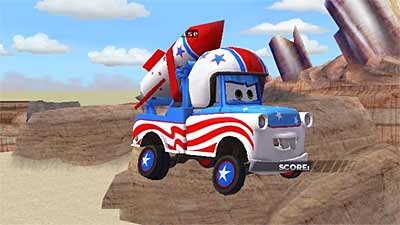
When it comes to actual races, both the handling and controls are pretty spot-on. Race-O-Rama doesn’t bring anything new to the table, but it does offer competent mechanics and interesting track design. Regardless of the similarities in scenery, each track has something unique to offer. Racing as a monster truck, however, isn’t one of the highlights of gameplay, and handling definitely gets a bit trickier any time you take the competition off-road. Additionally, the game’s physics are never all that great. Banging into walls or other vehicles usually means getting abruptly twisted in the wrong direction.
Wii owners get the added benefit of motion mechanics as an option to control their vehicles, and I have to say, it’s one of the few racing games where motion controls are preferable. Handling isn’t all that different from that of Excitebots, but for circuit races, especially, cars hug the road really well and it’s an exciting way to play the game. Conversely, using the Wii Remote and Nunchuk can be frustrating due to some poor button-mapping choices.
The entire racing experience is decidedly “arcadey,” with drifting, boosting, and even the ability to jump tossed into the mix. As one might expect, drifting is easier to execute on asphalt than it is on dirt roads and sandy beaches, but the mechanic works fairly well regardless of what type of terrain you’re racing on.
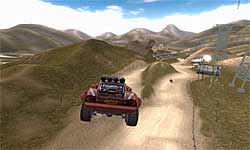
There are three levels of difficulty, and even in Beginner, the A.I. during story mode offers a decent challenge. There are no rubber-band antics, thankfully, but players will have to run a clean race in order to place first in events. In addition to the main races that progress the story, you can take on optional challenges along the way. These mini-games are mostly variants of other races or stunt challenges that, though little more than a novel distraction, add a bit of value to the overall package.
When you’re not making your way through the story, you can take a break in the Arcade mode. Basically, everything you’ve unlocked in the story mode will be available for you to play here with a friend or family member. The Rust Bucket Derby, Circuit, and Monster Truck Races are all tracks and racing types you’ve already played through in the story mode, and it’s the same for the mini-games and other challenges in Arcade. There are missions that require you to drive to a certain locale before time runs out, oftentimes performing a photo-op at the end of the mission. Lastly, is Guido Kart, which, with the exception of a handful of unimpressive, passively activated power-ups, isn’t all that different from the game’s normal racing.
In spite of the fact that Race-O-Rama offers a hefty selection of gameplay options and content, it suffers from poor optimization; it’s an overriding factor that crops up at almost every turn in the game. For one, the load screens are long and there are plenty to wade through. Choose a track – load screen. Choose a car to play as – load screen. Once a race is completed… you get the picture. Load times can be anywhere from 30 seconds to a full minute in length.
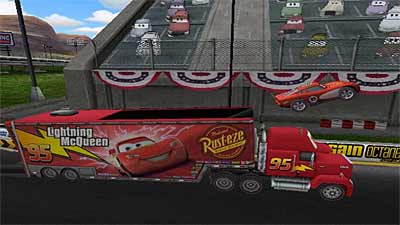
Unfortunately, the visuals are another major issue with Race-O-Rama, as they drag down the gameplay experience significantly. The amount of pop-in when driving through areas of the world is atrocious, and there’s no end to the shimmer. Though the car models and overworld areas all have a generally attractive aesthetic, matching the license fairly well, jagged textures and an overall lack of detail diminish what character the game has to offer. More importantly, however, the framerate drags; it’s usually constant, but constantly chugging. I wouldn’t go so far as to say it ruins the gameplay, but in a racing game, a slow framerate definitely hurts.
If you’ve played one Cars game, the music, dialogue, and sound effects here will all surely ring familiar in your ears. The same twangy themes fill up the background during races or when perusing the menus, and though you’ll likely recognize the voices of many of the game’s actors, they’re all canned performances, repeated far too many times throughout the duration of the story.
Again, we have to ask: Why? Is there really that much demand for more Cars-related video games? If so, fans could do worse than Race-O-Rama. The vehicles handle well, and there’s definitely plenty of single-player content for the money. That being said, the game is poorly optimized and brings absolutely nothing new to the racing genre. The open-world structure of the story mode is a neat concept, though the world itself isn’t very interesting. Wii owners might find novelty in the motion controls, but they’ll just as likely be wondering where the online multiplayer is.
RATING OUT OF 5 RATING DESCRIPTION 2.5 Graphics
Car models look attractive, and the variety of environments is appreciated. However, there’s constant shimmer, the textures are bland, and the framerate isn’t up to snuff for a racing game. 3.8 Control
The traditional-style controls work fine, but nothing about the gameplay feels all that polished. Motion controls for the Wii version, however, are surprisingly entertaining. 2.9 Music / Sound FX / Voice Acting
There’s very little variety in terms of music, and the sound effects are uneventful. There are sprinklings of voice work throughout the game, but it’s mostly all canned one-liners. 3.0
Play Value
There’s certainly no shortage of content in Race-O-Rama, and quite a few of the tracks are truly enjoyable. However, the overworld has had little love put into it, and there are many minor issues and bugs that come together to create a fairly uninspired package.
3.0 Overall Rating – Fair
Not an average. See Rating legend above for a final score breakdown.
Game Features: