Call of Multiplayer
October 9, 2008 – After the juggernaut that was Call of Duty 4: Modern Warfare, it wasn’t surprising that the announcement of Call of Duty: World at War met with such reluctance. Many fans feared that since the game was going back to World War II and being developed by Treyarch, as opposed to Infinity Ward, it would be a step backwards for the series. If the multiplayer I had a chance to experience is any indication of what we can expect from World at War, Call of Duty fans should fear no longer.
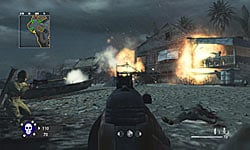
Rather than reinventing the wheel, World at War takes everything that players loved about Modern Warfare’s multiplayer and even adds a shiny rim and a slick spinner. The perks are back with some new additions, including shades, which reduces the blurring and blinding effect caused by flares, and gas masks, which help better protect the player from chemical-based weapons. The perks are earned in the same fashion as in Modern Warfare, gaining experience from your online prowess, moving up in military rank, and receiving a perk when you do so.
With the new vehicles such as tanks that come with a secondary gunner seat that players can take advantage of in multiplayer, there are also some new vehicle perks as well. The one I was able to utilize was water cooler, which made the tank’s mounted machine gun take longer to overheat. These tanks can definitely turn the tide of most battles, as they are heavily armored and pack some serious firepower. They can also be incredibly difficult to take down, requiring quite a few rockets and sticky grenades to make a dent in its armor.
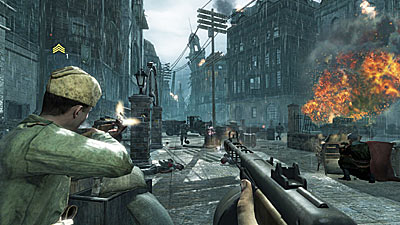
Also on display was a new play mode called War. In this mode, there are points on the map that need to be captured one at a time by your team. Of course, the other team is attempting to do the same, so these capture points end up being a mass grave for both teams. Whenever a team successfully captures a point, the momentum of the match turns in their favor, making capturing the next point quicker and easier for that team. This momentum is an interesting addition, but it did tend to make these matches incredibly one-sided. I suppose if you had a skilled team of friends working together, it would be possible to come back from a deficit, but with a bunch of strangers it seemed incredibly futile. Almost every match was won by the team that was able to capture the first point on the map.
The maps in World at War are also well-constructed and varied, ranging from bombed out cities to a hut-filled village on the edge of the ocean. The latter map was called Makin, and it offered an interesting backdrop for capture the flag. When playing in Makin, there were several out-of-the-way courses one could take to sneak up on their opponent’s flag. On one side was the ocean, which could be traversed with players walking under the supports of the overhead huts. The other side was made up of some jungle paths that provided excellent cover, making survival and stealth much easier.
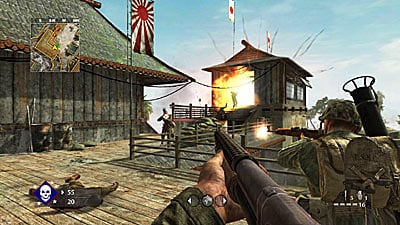
As in Modern Warfare, World at War also rewards players who manage to go on kill streaks. After three kills in a row, players will get a recon plane, five will net you an artillery strike, and seven gets you one of the funniest and most interesting things I’ve seen in a multiplayer game. As soon as you’ve scored your seventh kill in a row, players will hear Gary Oldman scream “Unleash the dogs.” When this occurs it means you now have a pack of vicious dogs that will seek out and attack your enemies. There aren’t many things funnier than sneaking your way to an opponent’s flag and having experience points constantly popping up in your window from team Cujo’s handiwork.
Perhaps the biggest surprise to come out of my time with World at War was its competitive co-op mode. In this mode, players will need to work together, all the while competing against one another for the high score. As a four person team, players will make their way through levels from the campaign, getting points for killing enemies and healing teammates. When you are mortally wounded in this mode, you will lose points and have a limited amount of time in which a teammate can save your life. If a teammate fails to heal you before you bleed out, your team will have to restart from your last checkpoint. The balance that this mode strikes between working together and competing is interesting to say the least and really has me excited to play through the game in this mode once it is released.
You will definitely need to function as a team to survive, as levels like the one I experienced, entitled Relentless, certainly lived up to its name. In Relentless, players are frequently pinned down behind cover, as seemingly endless hordes of Japanese soldiers rush and attack you from every direction. While playing this level there was nary a moment in which I wasn’t firing, reloading, healing a teammate, or bleeding out waiting for a helping hand and a healing touch.
Although World at War takes Call of Duty back to World War II, it still manages to feel different than pre-Modern Warfare Call of Duty titles. Besides being set in the Pacific Theater, much of this is thanks to Treyarch borrowing from what Call of Duty 4 did right and improving upon it as well. Even with the game’s older weapons and setting, fans of Modern Warfare’s multiplayer should definitely give this game a try when it is released this November. It may be World War II again, but it is far from the same old Call of Duty.
Game Features:
The Return of World War II
June 23, 2008 – There is a sense of apprehension – the next Call of Duty isn’t being handled by Infinity Ward and is returning to World War II. Those two details don’t exactly lead to an open embrace from fans of the series and relative newcomers. Treyarch – the developer this time around – if anything, is set on making this Call of Duty more than just a placeholder in the franchise’s history. “We’re going to own the World War II market,” says Treyarch Studio Head Mark Lamia. But is there any vitality left in the World War II genre?
The key – the developers outline – is to retain the gritty narrative put in place by Call of Duty 4: Modern Warfare. In a sense, this won’t need to be forced. This time around, the focus isn’t squarely on the Western Front but rather the Pacific theater and Russian campaign. The brutality in those areas is more front-and-center: the Japanese (during World War II) were known for their to-the-last-man tactics and the German assault on the Soviet Union led to 23 million Soviet casualties (this figure includes both soldiers and civilians).
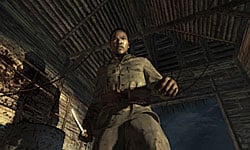
The more ruthless source material is apparent as soon as the development team loads up a level from the Pacific campaign. From the perspective of a captured American P.O.W., you see only two to three things in your immediate surroundings: the inside of a hut, a fellow P.O.W., and some Japanese soldiers marching in your direction. Stuck on the floor, you can only watch as a Japanese soldier lights a cigarette and extinguishes it in the other P.O.W.’s eye. However, rescue comes quickly, as a team of U.S. soldiers kills your captors and leads you out of the hut. It’s here where the game enters FPS mode proper – you’re thrown in a squad and forced to fight your way out of the Japanese camp and escape into the jungle.
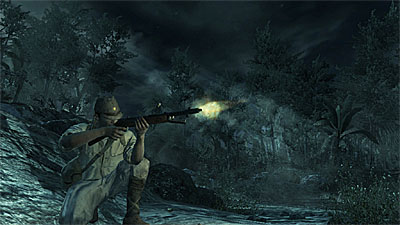
Even though the level is set during nighttime, graphical details stand out right away. For one, the game (even in an unfinished state) runs at a consistent framerate (thanks, no doubt, to the Call of Duty 4 engine). Other small touches are there as well; the moonlight hits the top of waves causing a shimmer effect, and tree branch shadows stretch out over the ocean. But the star of the show is the fire effects – exemplified by the flamethrower. You can spray any part of the environment and the fire will react realistically. For example, you don’t need to light an entire field on fire, wasting all your ammo. Instead, you can just spray a small patch of grass and the fire will spread. “Fire will be used as a tactical element,” says Lamia. During our demo, the fire spread over a field and found some unsuspecting victims – a couple of Japanese soldiers completely engulfed in flames rose out of the grass and rolled around the ground in a panic.
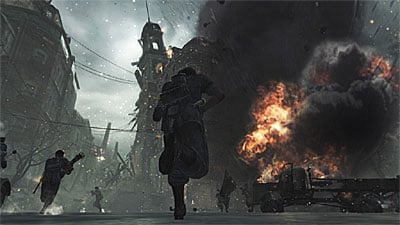
In Call of Duty 4 the narrative changed from level-to-level. This was accomplished by keeping you in a constant first person perspective and doing away with the notion of a main character – your goal was to be a particular character for the length of a level in order to move along the story. Treyarch is borrowing a page from Infinity Ward’s book and replicating that technique in World at War. While the first demo level we were shown featured a U.S. soldier, the second level switched fronts – it put you in control of a Soviet soldier in a sniper unit. Stranded in the middle of a town square, the sniper wakes up to find most of his fellow comrades dead, being picked apart by crows. A group of German soldiers arrives and empties a couple rounds into the Soviet bodies and then moves along. The sniper is spared and proceeds over to the other lone survivor – an older sniper. The next bit played out like a scene from the 2001 film “Enemy at the Gates” – the sniper waited for airplanes to commence bombing runs and then, with the help of the convenient sound cover, took out a small squad of German soldiers.
Multiplayer is another area where you can spot parallels to Call of Duty 4. Features from that game – such as the kill cam, gun unlocks, and kill streaks – will be included, as well as a squad leader way-point system. Treyarch wants to minimize the number of spawn kills and is working on a system that they claim will make sure players don’t spawn next to a rocketeer or directly in front of a sniper’s scope. Treyarch did not list a full vehicle set for multiplayer, but tanks were mentioned. Co-op will be available in multiple configurations for the single-player campaign – there will be two-player split-screen and four-player online co-op, as well as co-op specific challenges. Playing co-op with friends should net XP, which can be carried over to online unlockables.
While the Call of Duty 4 engine has helped Treyarch hit the floor running, the biggest factor on their side is time. Their last effort – Call of Duty 3 – had an incredibly short development cycle – it was pushed out in under a year. This time around, the team has had two years, and that’s allowed for more creative latitude. The game is scheduled to ship on nearly every major platform, but our guided demo showcased just the 360 version. The release date is still up in the air and that’s okay – Treyarch seems to be taking its time to produce a polished experience. Call of Duty: World at War looks to be in very capable hands.
Game Features: