The War at Home
We recently got the chance to sit down with the multiplayer aspect of Homefront, and while we came away impressed, it was the single player aspect that we were most interested in. We recently attended the THQ Montreal studio opening and while there we were able to get some hands-on time with the first level of Homefront. And from what we saw, players are definitely in for a ride when Homefront releases next year.
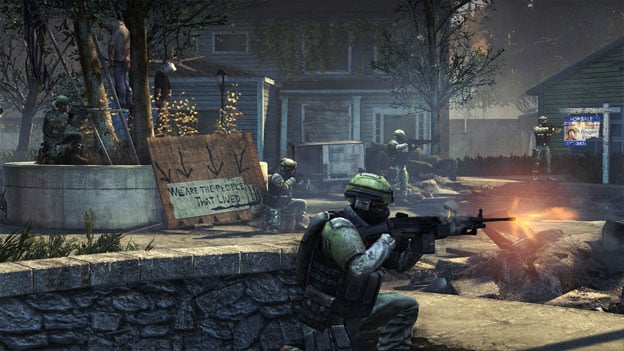
In case you haven’t heard, Homefront takes place in the speculative world of 2027, after the Unified Korean Forces have invaded the US. The game’s fiction aims to present a view of war from a resistance perspective, using views that are familiar in context, but alien in the way they have been twisted. This premise is demonstrated well in the game’s opening moments. When you first start the game, you are a nameless person just getting out of bed. The radio is on, and the morning show personality is giving the latest news and weather. However, the radio personality’s voice is incredibly grim, and then he begins reading the news in Korean. Suddenly, a knock at the door. Korean soldiers appear, accuse you of treachery, and pack you into a bus for a fate that is (presumably) worse than death.
The bus ride portion of the game serves as an interactive cutscene where you can look left and right and get a feel for how the world has changed since the Koreans invaded. Naturally, the scene is bleak, and you’ll be witness to plenty of abuses and executions in the street. There are bodies strewn across the sidewalk, and you’ll see people in various forms of torture and interrogation in broad daylight. One poor soul even gets shot execution-style while the bus passes by, which leads to some brain matter being splattered on the window. These horrifying images set the tone for the game and are effective tools for getting you into Homefront’s narrative. I have to admit though, there is one moment that is so harrowing (I won’t spoil it for you here, but let’s say it involves a child and its parents) that I had to press the pause button and take a moment to digest before moving on. I would be surprised if this moment didn’t generate some serious controversy when the game releases next year, simply because it is the type of violence that you just can’t become desensitized to.
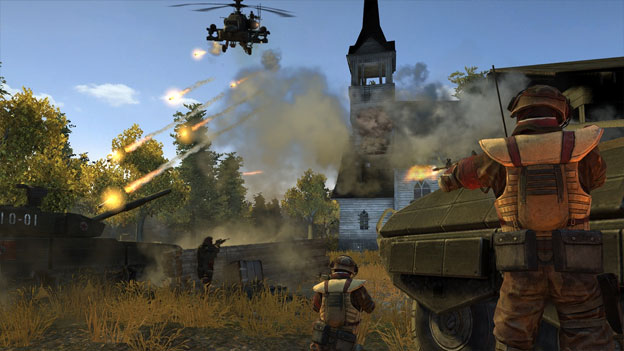
Once I was off the bus, the action began. From start-to-finish, Homefront feels like a conventional first-person shooter, which is a good thing. You’ll pick up weapons, throw grenades, find cover, and of course try to get as many headshots as possible. The AI was not terribly difficult to overcome, but the game puts you in tough situations where you can’t maneuver your way into an easy kill, which is certainly a triumph of the level design. You won’t really be able to “run-and-gun” through most areas, and the game forces you to take your time in some areas, which works well in the context of the narrative.
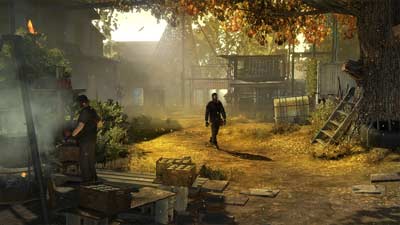
It is obvious that the developers want to the player to experience the world of Homefront as they are mowing down tons of enemies, and the first level shows off this aspect of the gameplay. The most impressionable part of the first level for me was definitely the setting. Even though the opening cutscene lets you know what is going on, you get a feel for the everyday horror of the situation while you are having shootouts in everyday places. The first level takes you through plenty of familiar locations including abandoned grocery stores, a backyard playground complete with treehouse (which now doubles as a lookout post), and even into a civilian’s home (complete with crazed mom and screaming baby.) The setting is visceral and dynamic, and definitely is one of the most memorable parts of the game (along with the opening bus cutscene.)
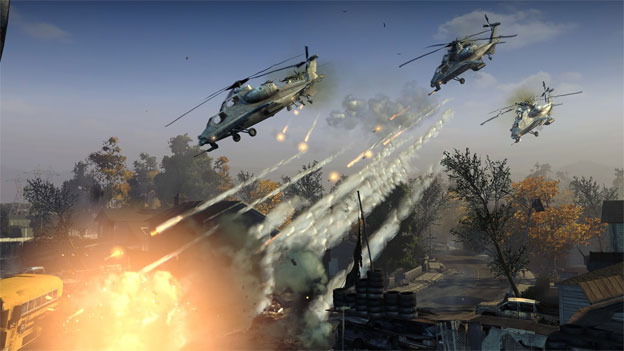
The first level isn’t long, but it sets the stage nicely for what should be (according to the developers) a six to eight hour experience. While the gameplay wasn’t the most innovative, it looks like the story combined with the setting will make Homefront a standout experience when it releases next year.
Game Features:
Defend the Homefront!
Homefront has definitely been a title long in development, and we’ve gotten quite a bit of information on the game’s single-player component over the past two years. The game’s premise is simple, but engaging. The year is 2027, and after a meteoric rise to power, the Greater Korean Republic has taken over the Asian peninsula and has now invaded the US. Unfortunately, the US is falling, and the resistance has to resort to guerilla-style warfare in order to thwart the ever-present threat of the Korean troops.
The single-player portion of the game is certainly going to be intriguing, but at a recent event, we were able to get a first look at the game’s multiplayer mode, which looks like it will be just as engrossing at the single-player mode.
The context for the multiplayer is within the scope of the game’s narrative, and sees your self-made character fighting the good fight for either the American or Korean sides. Because the focus in Homefront is squarely on the single-player experience, representatives from Kaos studios told us that they wanted the multiplayer aspect of the game to reflect the total chaos that will be portrayed in the story. The game will feature multiplayer modes that will allow up to thirty-two players at a time engage in combat, which should definitely ramp up the action considerably.
Although the setting and scope should certainly give Homefront a unique take on the online shooting experience, the real innovation here comes from the game’s unique load-out and currency system. During each multiplayer event, you will start the game with a set number of “Battle Points,” which are a performance-based currency system. The amount you start off with won’t be much though, and you’ll have to earn more by completing objectives, achieving kills, and making captures. As you accrue battle points, you will be able to unlock special weapons and vehicles.
However, the game wants to emphasize strategy, so the vehicles and weapons to which you will have access with your battle points will be selected via load-out at the beginning of each round. Each load-out gives you access to a variety of different weapons, drones, and vehicles once you accrue enough battle points. Some of the items, such as a rocket launcher with two rockets, only require a nominal amount of battle points, and can be spawned rather quickly after only a few kills or completed objectives. However, vehicles and drones will take a little more effort to unlock. This forces the player to form a “spend or save” strategy where they can either continue to unlock small bonuses with continuous battle points, or save up through several rounds to get a huge base-destroying tank.
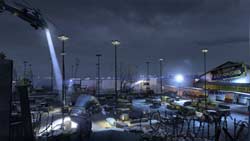
After learning about some of the broader aspects of the multiplayer mode, we were finally able to go hands-on with a pre-alpha build of a territory-stealing mode. We were able to check out two maps, tentatively titled “farm” and “cul-de-sac.” Both of these maps are set in a suburban landscape, complete with single-family homes, churches, and car junkyards. Of course, since this is a warzone, everything is in a particularly poor state, and bodies of unfortunate would-be soldiers hang from trees in the middle of the street. Although we were told that the look of the game was far from complete, the visual styling is mightily impressive thus far.
The game controls as you would expect from any first-person dual-stick shooter, and it was very easy to pick up and play. We were able to try out all of the game’s default guns, which included a middle-of-the-road assault rifle, a sniper rifle, and my favorite, a heavy assault gun known simply as “Scar”. Although the weapons list wasn’t exhaustive, there was enough variety in the different load-outs to help you stay within a certain strategic parameter.
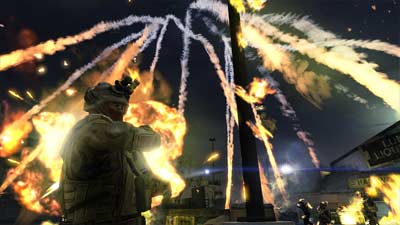
But as I mentioned before, the load-outs are much more than just your primary weapon, and give you access to different unlockables with the battle points system. I was able to check out several of the battle points unlockables, including areal drones and a giant tank. Although there is a bit of a learning curve with some of the vehicles (the drones in particular can be tough to maneuver at first), I had no problem slipping into these special vehicles after about a half-hour of playtime.
I also tried out different strategies in regards to the battle points, and found both spending them immediately on small arms as well as saving them for huge vehicles to be effective ways to enhance the gameplay and overtake enemies in my designated territories. Although the immediate success of both of these strategies may have been due to the fact I was playing with thirty other first-timers, I’m sure after playing for a while savvy players will develop specific approaches using the battle points system that will yield interesting results.
Although we were only able to spend a limited amount of time with the multiplayer portion of the game, we were promised that more information about additional modes, maps, and weapons would be forthcoming when we get closer to Homefront’s release next year. But for now, Homefront multiplayer is looking like an interesting way to augment what is sure to be a memorable single-player experience.
Game Features: